
Contemporary Learning
Mater Dei Catholic College provides a holistic education in which each student is challenged to develop capacity to regulate their own processes for learning.
Students are encouraged to be active community members, to work effectively with peers and teachers, to have a strong faith which guides their decision making and underpins their values, and to strive to achieve their personal academic best.
A Mater Dei education is one in which the elements of faith, learning and community are present in the education of young people. Learning should be transformative, so that students’ learning becomes part of who they are as they grow and develop into adults.
Students at Mater Dei should develop a love of learning based on the sense of accomplishment that arises from successfully navigating challenges. They engage with passionate, exemplary teachers who value relationships built on the dialogue of teaching and learning. Growth as a whole person is at the core of learning at the College.
An integral component of the Mater Dei learning program is a knowledge-rich curriculum. Through their acquisition of knowledge, students should come to a more developed understanding of the world around them. Such knowledge and understanding allows them to engage in critical thinking and real-world problem-solving, to develop the skills of independent and life-long learning.
Students also learn about the effective use of ICT, literacy, numeracy and academic integrity. They are taught explicitly about the Cardinal Virtues: Prudence, Fortitude, Temperance and Justice and have opportunities to put these into practice.
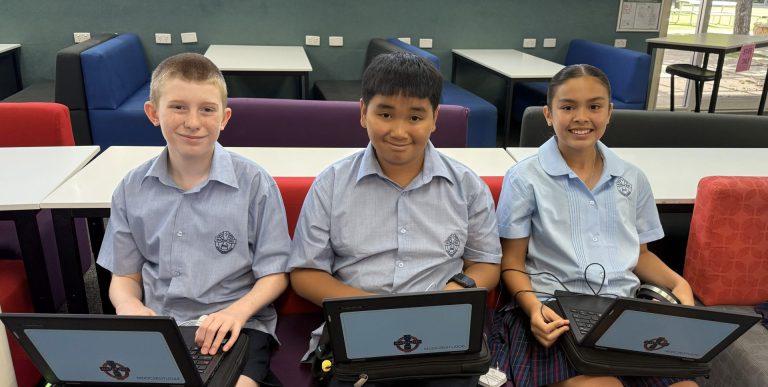
Year 8 students participate in the STEAM program. STEAM is the integrated teaching and learning of Science, Technology, Engineering, Art and Mathematics. The cross-curricular teaching of these key learning areas mirrors the practices of university and TAFE sectors, in conjunction with industry leaders such as Westpac, BAE Systems and Johnson and Johnson. International research also indicates that 75% of the fastest growing occupations now require STEAM skills and knowledge (Australian Chief Scientist, 2014).
This year, students will participate in units such as Makerspace Sandpit, MBot Golfing Challenge, Design Challenge and the Solar Car Challenge. This subject will benefit students by building the skills needed to actively contribute to society and influence scientific developments through innovation, both now and in the future. (NSW Education Standards Authority, 2017) These skills include:
- Complex problem-solving skills
- Critical thinking
- Creativity
- Collaboration and negotiation
- Judgement and decision-making skills
- Practical skills in designing and making
The REAL Project
The REAL Project is a Mater Dei learning initiative. Year 9 is a time when young people may become disengaged from school, struggling with their changing bodies and places in the world (Ambrosy 2023). In this program, we use project based learning to develop students’ thinking about social justice problems, developing their social and personal capability. Across different projects, our young people engage and work together to research, design and test solutions to community problems. Students receive self, peer and external feedback, helping them to embrace their strengths, develop their weaknesses, and to use their abilities to improve the world around them.